Thursday, October 4, 2007

Palompon barbeque boulevard


PALOMPON, Leyte -- Barbecue Boulevard, the newest attraction here, has been attracting locals since its completion a few months ago. Located at the breakwater near the port area, it is part of the P28.5 million improvement of the public market. The place used to accommodate stalls that serve breakfast like puto maya and hot chocolate.

Now, it is a tile-coated tourist attraction that draws promenaders. Considering that the plaza beside the town hall is not presentable, the barbecue park is now the favorite of people who want to relax by the sea. At nighttime, barbecue vendors set up their tables and serve food. Some of these vendors used to crowd the bus terminal, which was why they were transferred.

Leyte’s bird sanctuary still safe for tourist


PALOMPON, Leyte -- The Tabuk Marine Park and Bird Sanctuary here remains safe for tourists despite the bird flu scare. This was the assurance made by Horeem Urboda, head of the Human and Ecological Security Commission, who said that the municipal government is closely monitoring the 222-hectare sanctuary.

Urboda pointed out that there has been no reported deaths nor unusual movements of migratory birds since the formation of a special task force on the Avian Influenza on November ’05. The Philippines is along the Southeast Asia-Australia flyway used by birds from the Northern Hemisphere. These birds from Siberia migrate to Asia in September then return home by March. Urboda said the sanctuary continues to be visited by students, environmentalists and other government employees on study tours.

Among the bird species that can be seen in the islets are Philippine mallards or wild ducks, Asiatic Dowitcher, Chinese Swinhoe’s Egret, etc. Urboda also informed that there has been no reported deaths of domestic fowl in the town, even from the large and medium scale poultry farms in the upland barangays of Tambis and Lat-osan, some 10 kilometers from the poblacion. The sanctuary, on the other hand, is located some 300 meters across the mainland.

Dr. Laarni Cabantac, asst. coordinator of the National Avian Influenza Task Force, told participants of a seminar workshop in Cebu this week that migratory birds are the usual natural carriers of the virus that can affect the country’s poultry industry. But she also clarified that there are other modes of transmission like the importation of wild birds and unsanitary poultry farms.

Tabuk was declared as a marine park and bird sanctuary in 1995 through an ordinance enacted by the municipal government. After it was adjudged as 1997 Galing Pook Awardee, the sanctuary was declared as an eco-destination. Amenities were constructed, and tour package has been organized that includes, bird watching, trip to bat kingdom, marine safari, trip to mallards lair, scuba diving and snorkeling.
Typewriters, old sewing machines, metal plates, etc.

The museum in Carigara town is indeed a depository of old things that belongs to the people in those era. Lamps, glass jars, kitchenwares, are among the items found here.


The municipal museum is an evidence that Carigara is the regional capital of Region 8, long before Tacloban and other towns were established.
Still part of the municipal museum here..,...

The devotional garden, part of the ruin of Carigara church, that was used as "dagkotanan" today.


The belfry of the old church in Hilongos, Leyte.

The church in Tanauan, Leyte, one of our destination in the Heritage Tour.

May 1, 2007-ARCHITECTURAL HERITAGE TOUR
Carigara church
Carigara museum
Cassidy Elementary School
Gawas an Harigi, Carigara, Leyte
Palo Metropolitan Cathedral
Tanauan church
Dulag church
Baybay church
Kuta de Hilongos

History and heritage: treasures from the past


The ruin of the 1595 Carigara church at Binongtoan, some 3 kilometers from the town proper. It was only restored during its 400 years anniversary last 1995.

The author, in the 1596-Dular seminary ruin beside its church which was also reduced to rubble during the liberation in 1944. The author, Gerard Reyes is one of the participants of the architectural heritage tour sponsored by Dept. of Tourism last May 1, 2007.
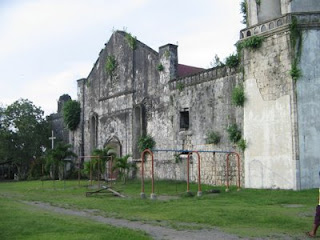
The old Hilongos-which is the mother parish of my hometown-Palompon.


By: Gerardo C. Reyes Jr.
Discovering the richness of our architectural heritage in Leyte is indeed an amazing and satisfying time travel to centuries ago. Although, very little is known about the fascinating story of the life and culture of our forefathers and early settlers in this province, but these old structures tells us more about their existence.

Unlike in other forts in some parts of the country, Leyte has its unique “kuta” with the church inside the massive fortification of stones. The church is enclosed with a stone- wall and watchtowers to protect the early settlers from the violent Moro raids some centuries ago. Both, Tanauan and Dulag has walls around their churches, but only that in Tanauan still exists until today. Even Palompon and Ormoc churches has also a massive stone walls but was only reduced to rubble, before the townspeople could preserve it. But in Hilongos, Leyte, its history-conscious inhabitants wants to remain these walls untouched and preserved the church ruin. Today, only Hilongos, where we can find a church with a fortification, it is unlike in Fort San Pedro, Fort Santiago, Fort Pilar and other walled cities in the country.

These old walls tells us a very fascinating story, that early settlers survived the assault of the Muslim raiders centuries ago because they seek refuge inside these churches. They brought rice and other provisions, and most of these churches have deep wells inside that sustained their needs for potable water. They stayed there for five days or more and fought back by way of using bow and arrow (pana) with poisons, as evidenced in the book written by Manuel Artigas y Cuerva in Reseña de la Historia de la Provincia de Leyte.

The Architectural Heritage Tour last May 1, disseminates valuable historical and cultural information among us and instill a great sense of pride in our heritage and history as a people. Our country is truly a place of rice heritage, colorful history and vibrant culture. Leyte’s architectural heritage tour highlights the region’s historic sites, and its potential of becoming a tourist destination because of its historical places.

The town of Carigara, Leyte is a living representation of the region’s historic settlement encompassing architectural legacies. The Balay nga Gawas It Harigi, is truly a significant structure of the era and the only building in Eastern Visayas, with its posts visible outside (Gawas it Harigi, literally). Its century-old municipio was converted into a public library and museum with valuable items and historical artifacts that proves the province’s rich culture. Not only World War II memorabilla are found in the museum, but also centuries-old wares and stuffs, not limited to lamps, typewriters, plates and other kitchen wares, dress, Demi John (dama), which is a glass container of tuba and lambanog, old paintings, wood carvings, coins, icons and other antiques.

The ruins of the old church, built in 1595 are found in Binogtoan, (some few kilometers from the poblacion). The place was the old settlement of the early settlers in this town. It was only in 1995, during the Leyte’s Jesuits Evangelization 400 years anniversary, when the ruin in Binogtoan was protected and preserved. The place was inhabited by squatters with the their houses within the ruins of the old church.

Palo Cathedral is also one of the oldest churches within the province, but its renovation wiped away its architectural richness and antiquity, although, centuries-old items and icons are found inside the church. In Tanauan, people will understand better the struggle of early Leyteños during the onslaught of the Moro raids. The stone church was built to protect the inhabitants from Moro bandits. The fortification of coral stones around the church and its watchtower “tan-awanan” or “tan-awan” became the name of its town. The old walls are still present and visible though it is already a structure worn out through time. Some portions of the church’s wall are original coral stones and tiles, and some of it are renovated.

Dulag’s church could have been the oldest in the province, but the shillings by the Liberation forces during the World War II reduced this huge structure to rubble, including the oldest school. It was the oldest school built in 1595, older than the other schools in the country said Mayor Themestocles “Timmy” Saño.

Baybay, Leyte is another historical spots in the region. It has several century’s old houses within the poblacion. Its old stone church is similar to that in other churches in the region. It was made of massive blocks and coral stones, with its façade and other portions of the church that remained untouched unlike in some other churches.

Hilongos is a classic example of a well-preserved fort (kuta) and church. Hilongos way back in 1700’s was already a parish with its neighbring towns included as its jurisdiction. In Palompon, early settlers sailed to Hilongos to attend masses every Sundays. The frequent Moro raids made the Leyte churches unique, with fortification of massive coral stones. The church in Hilongos was buit in 1737, but during the American occupation, a Katipunero, Francisco “Kikoy” Flordeliz, was forced to surrender by the US forces, but he refused. The whole town of Hilongos was burned including the church. But the ruin was masterfully renovated not to touch the original architectural make-up of the structure. The old church is still there, but an extension was built in 1960’s. The ruin of the altar was transformed into a devotional garden (dagkutanan) with statues of saints and decorated with ornamental plants and flowers.

How people treated the heritage sites?

People of this generation treated these architectural heritage sites differently, in Binogtoan ruins in Carigara where the 1595-church stands was completely abandoned for hundred of years before it was transformed into a park only in 1995. Secondly, some of the old structures was stored and preserved for the younger generation to understand our past, like that of Dulag church. Third, people wanted to make the place integral to modern needs like that of Hilongos church. The ruin of its altar was transformed into a devotional garden, and some of the old walls of the church (that was not completely burned in early 1900s) served as the main altar of the church (extension in Hilongos was built in 1960’s). Now, any effort to preserve and protect the Hilongos church is a joint undertaking of the parish and the local government unit.

Leyte is fortunate that its people work hard to protect and preserve its heritage sites which is significant part of our struggle as a people or else the younger generation would totally forget their past and might lose their sense of history

Ang Mabulukong Kagahapon


by: GERARDO C. REYES JR.

Matag usa kanato adunay “utang sa kagahapon”. Nahimo kitang usa ka malamboong komunidad karon tungod sa paninguha sa atong mga katigulangan og mga ginikanan kinsa mipatulo sa ilang singot, mibuhis sa ilang kinabuhi og gani mi-ula pa sa ilang dugo tungod og alang sa bag-ong kaliwatan.


Ang kasaysayan sa atong pagka-lungsod og pagkakatilingban maoy nagdugtong kanato ngadto sa mga hitabo sa kanhiay'ng panahon. Maoy magbukas o moabli sa atong mga mata niadtong mga mabulukong yugto sa atong kagahapon nga maoy hinungdan nganong “ingon kita niini karon”.


Malisod alang kanato sa pagdis-ug sa unahan og paglatas sa dalan nga atong padulngan kun dili nato lingi-on ang kagahapon nga maoy atong gigikanan. Og mao kini ang pagpakigbisog niadtong mga tawo nga mihatag sa ilang sakripisyo tungod og alang sa nasud og sa lungsod.

Angayan lamang nga ato silang pasidunggan, aron nga ang bag-ong kaliwatan makasabot sa kasaysayan og sa mga daghang mga panghitabo nga mao ang mga mabulukong yugto sa atong kagahapon.

Daghan usab ang angayan natong mahibaloan kon giunsa pagtubo sa lungsod sa Palompon-gikan sa usa ka gamay'ng puluy-anan daplin sa baybayon, hangtod nga nahimo kining usa ka parrochia niadtong 1784, unya usa ka malamboong pueblo, og hangtod karon. Unsa nga mga panghitabo kaniadto nga naghatod sa lungsod sa Palompon, karon sa iyang kahimtang? Kinsa ang mga tawo nga nahimong instrumento aron nga mahimong gawasnon ang lungsod sa Palompon gikan sa mga malupigong mga banyaga gikan sa habagatang bahin sa nasud-nga mao ang mga bandidong Muslim nga gitawag usab og Moros? Unsa ang mga nahitabo sa atong lungsod nga wala masayri sa atong mga kaigsoonan dinhi sa Palompon?

Kini og ang daghan pa pagatubagon sa atong ipagawas o ipublikar nga libro mahitungod sa KASAYSAYAN SA PALOMPON.Image

PALOMPON - a historic town


by: GERARDO C. REYES JR.

My native town-PALOMPON did not lack the historical episodes that made it interesting to trace its fascinating story that took place in the past.


It is the place where the fiercest battle among the early settlers and Moro raiders happened sometime in 17th and 18th century, or even earlier. Our forefathers stood defiantly and fought those Muslim pirates during that decisive encounter. Many among the local warriors perished, and some women are held captive one of them is a young woman named Tomasa, daughter of a local warrior and leader.


In reading the accounts written by Manuel Artigas y Cuerva, it open my eyes to a very interesting segment of our past that many Palomponganons did not know. There was a decisive encounter that repulsed the Muslim invaders and the natives were victorious. What made the book interesting (even if it is written in Spanish) is its provocative revelation.

If I will going to published my research about the history of Palompon, the book written by Artigas will be one of my principal source. History has three sources; namely, relics, oral tradition and written records. But it would appear to be reliable if our sources will be on records and published accounts written by early Filipinos, Spanish missionaries, or even historians. If I can publish this one before the end of this year, it will include the following;

  1. the early settlements in Leyte province

  2. the Bankaw revolt in 1621

  3. the origin of turugpo in Camansi, Carigara, Leyte

  4. the life of the early settlers in the coastal settlement

  5. the Jesuit missions before they reach Palompon

  6. the life of the early Palomponganons

  7. the Christianization of the natives

  8. the Moro raids in Palompon

  9. the man named Molo, and his lineage

  10. the fortification of stone build by the natives to protect the town from Muslim raids

  11. Palomponganons traveled by sea to attend masses and other religious activities at Hilongos, Leyte,(some 100 kilometers south of Palompon) its mother parish before 1784.

  12. Palompon celebrated its first Fiesta on 1784

  13. the image of the San Francisco Xavier and its possible origin

  14. the mystery behind the century-old cannon, (now displayed prominently at the plaza)

  15. the construction of the church and its builders

  16. the 9-day battle that resulted to the defeat of the invading Moros

  17. the blow-by-blow account of the Moro attacks written by Artigas

  18. the settlement in Baybay was established by a Palomponganon

  19. The island of Camotes (particularly in the town of Poro) was discovered by Jesuit missionaries from Palompon, and then thereafter they annexed their mission area to the island

  20. Ormoc, a part of Palompon parish from 1784 until 1851

  21. Ormoc gained its parochial independence because of their petition, due to the abusive attitude of a certain Fr. Samson of Palompon parish

  22. the cabeza de baranggay or capitan municipal of Palompon

  23. that the abaca industry was once a flourishing trade in this town, with some suppliers from Palompon and manual machines in weaving abaca.

  24. the number of voters in this town in 1900, and the socio-economic profile in the post-Spanish era, or at the start of the American occupation.

  25. the business partner of the Aboitiz, a certain Jose Muertegue live in Palompon sometime in 1900-1916 and engage in abaca trade. The flourishing abaca trading in this town. Their business partnership paved the way to the establishment of Aboitiz y Muertergue

  26. The justice system and administration in Palompon and other Leyte town's before the American regime, and the fiscal/ trial court judge who visited this town with area of assignment as far as Maasin, Southern Leyte.

  27. The typhoons and other natural calamities that hit Palompon

  28. the guerrilla movement during the American occupation

  29. The society and culture of the Palomponganons during the Americal occupation

  30. the guerrilla movement in Palompon from 1942-1944

  31. the conquest of Leyte and the decisive battle in World War II

  32. the historic landing of 77th division headed by Gen. Bruce and the end of Japanese resistance

  33. Palompon-after the war

  34. Contemporary Palompon

For more interesting details of the above-mentioned topics, WATCH OUT FOR THE RELEASE OF THE BOOK. COMING SOON!Image